

How Do Clean Skin Feel To The Touch
Imagine this. You wake up in the morning to the irritating buzz of your warning. Instead of fumbling for a snooze button, you moving ridge your mitt in the air in the full general direction of the clock. In that location, in mid-air, you notice information technology: an invisible button. It's an illusion y'all tin feel, similar a hologram for your fingers. One swipe at the button, and the alarm shuts off. Yous're costless to slumber for a few more minutes — fifty-fifty though yous never touched the clock.
The scientific discipline of affect is called haptics. Sriram Subramanian describes the floating alarm clock push equally 1 example of how a new technology called "ultrahaptics" might be used. "It does seem a flake far-fetched," admits this calculator scientist at the University of Sussex in England. But, he quickly adds, such a device is possible. Researchers in his lab now create virtual, three-dimensional objects that people can experience.

The secret to their success — sound waves. Really, information technology'south no hugger-mugger. A growing number of researchers around the world are investigating how sound waves can be used to simulate touch. These sound waves are ultrasonic. That means they're so loftier-pitched people tin can't hear them. At the same time, they're strong enough to put pressure on human skin and trigger the sensation of touch on. Scientists tin change the location and shape of a tactile (bear on) illusion by adjusting the audio waves, focusing them on a detail spot.
Invisible technology
An alarm clock with a levitating snooze push button is just one example. Tom Carter, an engineer, joined with Subramanian to launch a company called Ultrahaptics. Carter imagines a futurity in which people use electronic devices with a wave of the manus. He and other researchers say the touchscreens and keyboards on electric current devices are limiting. They wonder: Why can't nosotros use the air effectually our devices as some other way to collaborate?
Their inquiry points to a whole new way to use electronics. Drivers might control phones or radios past twiddling their fingers in the air — while keeping their eyes on the road. Video gamers could feel the imaginary worlds that they already see and hear in their games.
Hiroyuki Shinoda, an engineer at the University of Tokyo in Japan, has been studying haptics for decades. In 2008, he became one of the commencement people to use ultrasonic waves to float virtual objects in midair. Since and then, he has looked for ways for existent and virtual objects to interact. He thinks that ultimately, the approach could help people connect with each other. For example, the technology might simulate the sensation of touching some other person — like holding hands.
Subramanian says the idea of floating, three-dimensional illusions tin inspire the imagination. Even though he developed the technology, he's confident people will find other creative means to use it. Fellow scientists, entrepreneurs (AHN-trah-preh-NOORS) and politicians flock to his lab. And immediately they become inspired.
"Everybody comes up with their ain uses," says Subramanian. "It's astonishing."
Sounds and solids
Sound travels through the air as waves. Just these waves are non like the ones that movement upward and downward through h2o. A audio wave is an example of a longitudinal moving ridge. Information technology is made up of a series of compressions — places where the air is pressed together. To empathize how a longitudinal moving ridge travels, stretch out a spring. Give i end a quick button and pull, beginning toward and so abroad from the other cease. A compressed grouping of coils volition move downwards the spiral. In a audio moving ridge, air particles agglomeration together like those coils.
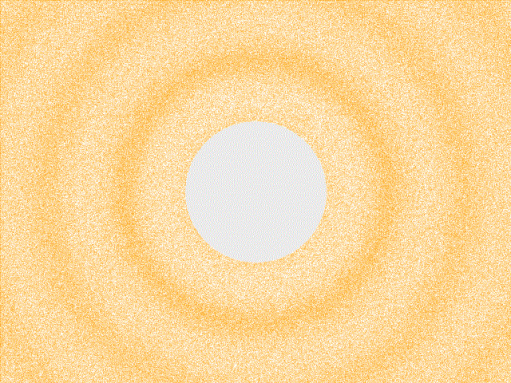
Anyone who has been to a loud concert knows about the connexion between sound waves and the feeling of touch. A depression bass annotation doesn't only reach the concert goers' ears — information technology too vibrates their bodies. Subramanian says the feel of feeling such depression notes inspired him to investigate sound waves.
The homo trunk detects audio and touch in like ways. Cells in the skin have nervus endings, chosen mechanoreceptors (Meh-KAN-oh-ree-SEP-terz). They detect pressure, which triggers the release of signals to the brain. The inner ear also has mechanoreceptors. Called hair cells, they convert sound into electrical signals that travel along nerves to the brain.
Whether a sound is high or depression depends on how many waves laissez passer a single point during a given time. This measurement is called frequency. The college the rate, the higher the frequency. Sound waves that brand high notes have a college frequency than practice those that brand low notes. An average person tin hear sounds upwardly to about 20,000 hertz, meaning xx,000 vibrations per second. (As people age, that upper limit drops. And so children and teens generally can hear higher pitches than tin older folks.) Ultrasonic waves are frequencies college than those that the homo ear can hear.
Many devices use ultrasonic frequencies. Some cars accept parking sensors that send out ultrasonic waves and observe those that bounciness back to identify obstacles. Medical ultrasound devices emit high-pitched sound waves to peer inside the body and "see" things, such as a growing fetus.
Feeling without touching
Physicists accept been exploring the physical feeling of sound waves for more 100 years. When sound waves striking the skin, their pressure level triggers the mechanoreceptors. But scientists have only recently looked for ways to utilize that knowledge in electronic devices.
Subramanian began thinking nigh using audio waves to control devices a few years ago. He had been working with touchscreens, which always feel hard under the fingertips. He and his colleagues wondered if instead, the screens could communicate with users before someone even touched the device. For instance, people might exist able to start a program by waving their hands in front end of the screen — not touching it. That led him to think about using ultrasonic waves to float objects in the air around the screen.
He started telling other people. "They laughed," he recalls, saying "This is crazy. It's not going to piece of work." But Subramanian's squad did not requite up. "Other people never believed in our ambitions," he says. "Merely they could not give the states a good reason why it should fail."
About five years ago, while he was at the University of Bristol in England, Subramanian began working with Carter. At the time, Carter was a higher student looking for an interesting project.
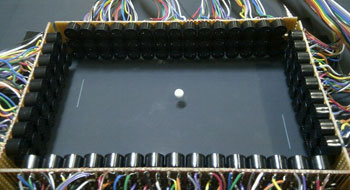
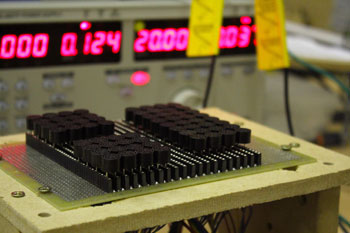
Subramanian, Carter says, "had this crazy thought that you could feel things without touching them." He asked Carter to build a grid of ultrasonic transducers (Trans-DU-serz). These are devices that send out high-frequency sound waves. His goal was to use those sound waves to push pocket-size objects.
After years of work, the researchers found a style to focus the ultrasound waves. Their device used 320 transducers continued to a calculator. That setup allowed them to melody those waves precisely and create the illusion of an object floating in space. They debuted their get-go ultrahaptic device at a scientific coming together in 2022.
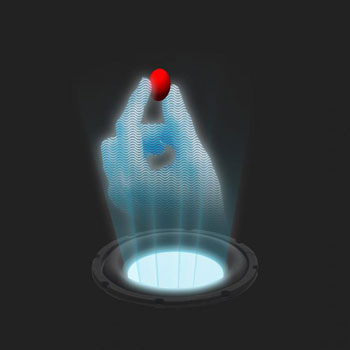
Since and so, Subramanian has continued to push the science forward. Terminal October, he and his team showed how ultrasonic waves could be used to levitate, move and guide small objects. They called their invention a "tractor beam" — an thought fabricated famous past scientific discipline fiction. Those beams were supposed to utilise free energy to capture objects, such as enemy infinite ships. The new acoustic tractor beam instead acts more like invisible tweezers.
Carter left graduate school to run the Ultrahaptics company. Next he wants to use the applied science to simulate the feeling of touching different textures. "We can tailor the sound waves to any blazon of vibrations," he says. At one frequency, the sound waves may experience similar dry raindrops falling on your hand. At a higher frequency, they may feel like foam.
"How do y'all feel anything? You lot experience information technology by sliding your manus across the texture," he explains. "Your peel is vibrating in a pattern every bit you drag it across." The idea, he says, is that "if nosotros can piece of work out those vibrations, we can start to recreate complicated textures like rough or smooth wood, or metal."
A personal impact
In Tokyo, Shinoda and his team recently unveiled a system called the HaptoClone. It uses a similar technology for advice. The system looks like ii bulky boxes, each big enough to hold a basketball. One box contains a real object. The other displays the object's reflection. Cheers to a series of mirrors betwixt the two, the copy looks and moves identically to the original.
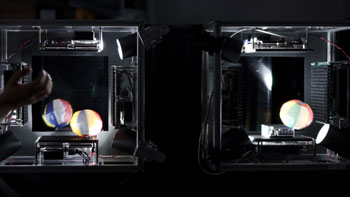
Shinoda and his squad also installed a prepare of ultrasonic transducers. These allow the real object and its copy to "communicate" past touch. For example, if a person pushes on the real object, it moves. And and so does the re-create. That'south obvious — and would happen for any reflection! But here's the interesting role. If someone reaches into the box and pushes on the reflection, their hand will truly experience it, because of the sound waves. And when they touch information technology, the copy will motion — as will the original. Any action done to one side happens immediately to the other.
For example, imagine that one side contains a real brawl. Someone can push on the reflected image — and thereby also shove the original ball out of its box. If ii people each stuck their fingers into the box, they would get the sense they had really touched each other — even though information technology had been sound waves creating that illusion.
"In the HaptoClone, real interactions between real objects tin be realized," says Shinoda. He thinks such a arrangement might be well-nigh useful for people who want to connect with each other. "Physical contact between people is very of import," he notes. "Whether it's simply shaking hands or stroking a person'due south peel."
| THE HAPTOCLONE With the Haptoclone, users tin interact with an epitome of an object in a box to dispense a real object in some other location. ShinodaLab |
Touching is a kind of nonverbal communication. He says information technology sends letters unlike anything people can say with images or words. He imagines a device like the HaptoClone may, for instance, help children feel closer to a parent who is far abroad.
"My mission is to assist people who have lost something," he says.
He'south even so fine-tuning the HaptoClone. Right now, the device is far too bulky to sell to people to go on in their houses. He'south working to make it smaller and easier to use.
Physicists may have first continued sound waves to feeling a century agone, but these new devices are truly cut-edge. They're also the result of hard work — often requiring years of research and testing.
Carter says his company, Ultrahaptics, began with an uphill battle. "Nosotros spent 18 months with our device non working, in various forms," he says. Merely the struggle was worth information technology. In fact, he thinks the technology is only possible because of the hiccups he and his collaborators encountered along the way.
"You larn all-time past declining," he says. "The fastest way to learn is to try to acquire, and fail, and learn how to fail fast. If y'all don't try to do something, you won't fail, and you'll never succeed."
Power Words
(for more about Power Words, click here )
acoustics The science related to sounds and hearing.
clone An verbal copy (or what seems to be an exact copy) of some physical object. (in biology) An organism that has exactly the same genes as another, like identical twins.
compression Pressing on ane or more sides of something in club to reduce its volume.
engineerA person who uses science to solve issues. Equally a verb, to engineer means to pattern a device, fabric or process that will solve some problem or unmet need.
entrepreneur Someone who creates and/or manages a major project, particularly a new visitor.
fetus(adj. fetal) The term for a mammal during its later on-stages of development in the womb. For humans, this term is usually applied after the eighth week of development.
frequency The number of times a specified periodic miracle occurs inside a specified time interval. (In physics) The number of wavelengths that occurs over a particular interval of time.
graduate school Programs at a university that offer advanced degrees, such equally a Primary's or PhD degree. It's called graduate schoolhouse because information technology is started only afterwards someone has already graduated from higher (ordinarily with a iv-year degree).
hair cellsThe sensory receptors inside the ears of vertebrates that allows them to hear. These actually resemble stubby hairs.
haptic Of or relating to the sense of touch.
hertz The frequency with which something (such equally a wavelength) occurs, measured in the number of times the cycle repeats during each second of fourth dimension.
hologram An image made of light and projected onto a surface, depicting the contents of a space.
illusion A thing that is or is likely to be wrongly perceived or interpreted by the senses.
levitation The act of suspending or causing to float in air a person or object — seemingly in violation of gravity.
mechanoreceptor Specialized cells that answer to touch.
nonverbal Without words.
particle A minute amount of something.
receptor (in biology) A molecule in cells that serves as a docking station for another molecule. That 2d molecule tin can turn on some special activity by the cell.
sensorA device that picks upwardly information on physical or chemical conditions — such every bit temperature, barometric pressure, salinity, humidity, pH, low-cal intensity or radiation — and stores or broadcasts that information. Scientists and engineers often rely on sensors to inform them of conditions that may change over time or that exist far from where a researcher can measure out them directly. (in biology) The structure that an organism uses to sense attributes of its environment, such as heat, winds, chemicals, moisture, trauma or an attack by predators.
simulate To deceive in some fashion by imitating the class or function of something. A false dietary fat, for instance, may deceive the mouth that it has tasted a real fat considering it has the same experience on the tongue — without having any calories. A simulated sense of bear on may fool the brain into thinking a finger has touched something fifty-fifty though a hand may no longer exists and has been replaced by a synthetic limb. (in computing) To try and imitate the conditions, functions or appearance of something. Computer programs that practice this are referred to as simulations.
sound moving ridge A wave that transmits audio. Audio waves have alternating swaths of high and low pressure.
tactile An adjective that describes something that is or tin can be sensed by touching.
applied science The awarding of scientific noesis for practical purposes, specially in industry — or the devices, processes and systems that result from those efforts.
tractor beam A device in science fiction that uses a beam of free energy to motility an object.
transducer A device that converts a variation in a physical quantity, such as sound, into an electric signal. It also tin convert an electrical signal into a physical quantity.
ultrahaptics A technology that creates virtual, 3-dimensional objects that can be felt without being touched.
ultrasound (adj. ultrasonic) Sounds at frequencies above the range that tin can exist detected by the homo ear. As well the proper noun given to a medical process that uses ultrasound to "encounter" within the trunk.
vibrate To rhythmically shake or to move continuously and rapidly back and forth.
wave A disturbance or variation that travels through space and affair in a regular, oscillating fashion.
Word Find( click here to enlarge for press )

Source: https://www.sciencenewsforstudents.org/article/feeling-objects-arent-there
Posted by: whiteyousigulas.blogspot.com
0 Response to "How Do Clean Skin Feel To The Touch"
Post a Comment